Introducing BetterDB for Valkey: A Free VS Code Extension
Browse keys, edit values, and run commands against Valkey and Redis without leaving your editor. MIT-licensed and open source.
If you work with Valkey or Redis, you've probably found yourself jumping between your editor, a terminal running valkey-cli, and maybe a GUI tool - all to check what's in a key or debug a caching issue.
We built BetterDB for Valkey - the first VS Code extension built specifically for Valkey - to keep you in your editor.
What it does
The extension adds a sidebar panel to VS Code where you can:
- Manage connections to multiple Valkey and Redis instances. Credentials are stored in VS Code's SecretStorage - not plaintext config files.
- Browse keys with pattern filtering (
user:*,session:*, etc.). See types and TTLs at a glance. - Edit values with type-aware editors for strings, hashes, lists, sets, sorted sets, and streams.
- Run commands in an integrated CLI with syntax highlighting and persistent history.
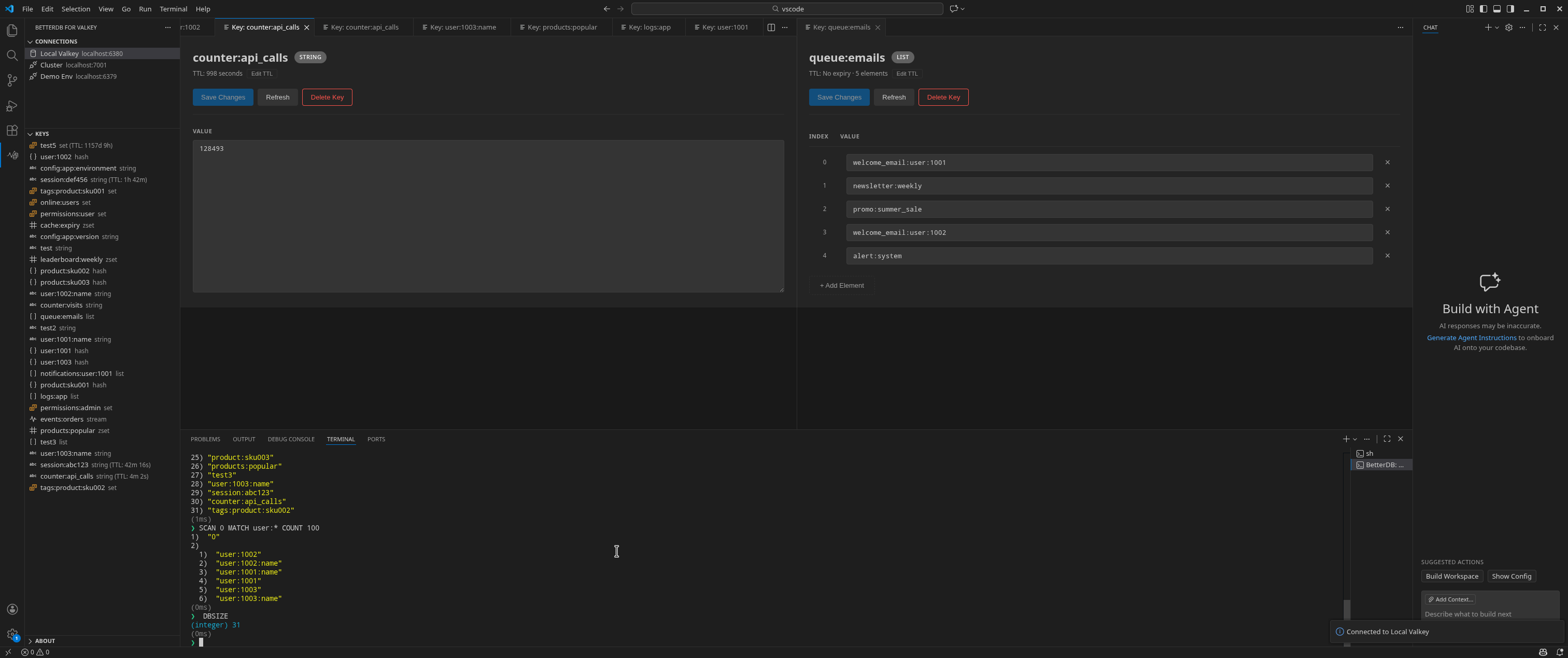
It works with Valkey 7.2+ and Redis 6.0+, so you can use it regardless of which fork you're running.
Why we built it
Since Valkey forked in early 2024, the ecosystem has been catching up. AWS, Google, and Oracle are backing the server, but developer tooling has lagged behind. We wanted to help close that gap.
The extension is:
- MIT-licensed - use it however you want, no license concerns
- Valkey-first - built with the iovalkey client library
- Lightweight - does what you need without the bloat
Getting started
Install from the VS Code Marketplace, click the database icon in the activity bar, and add a connection. That's it.
For TLS connections or advanced configuration, check the extension repository.
Open source
The extension is MIT-licensed and we welcome contributions. Found a bug? Want a feature? Open an issue or send a PR.
BetterDB for Valkey is part of the BetterDB ecosystem - observability and tooling for Valkey. The monitoring platform is now in public beta with self-hosted Docker deployment available.